
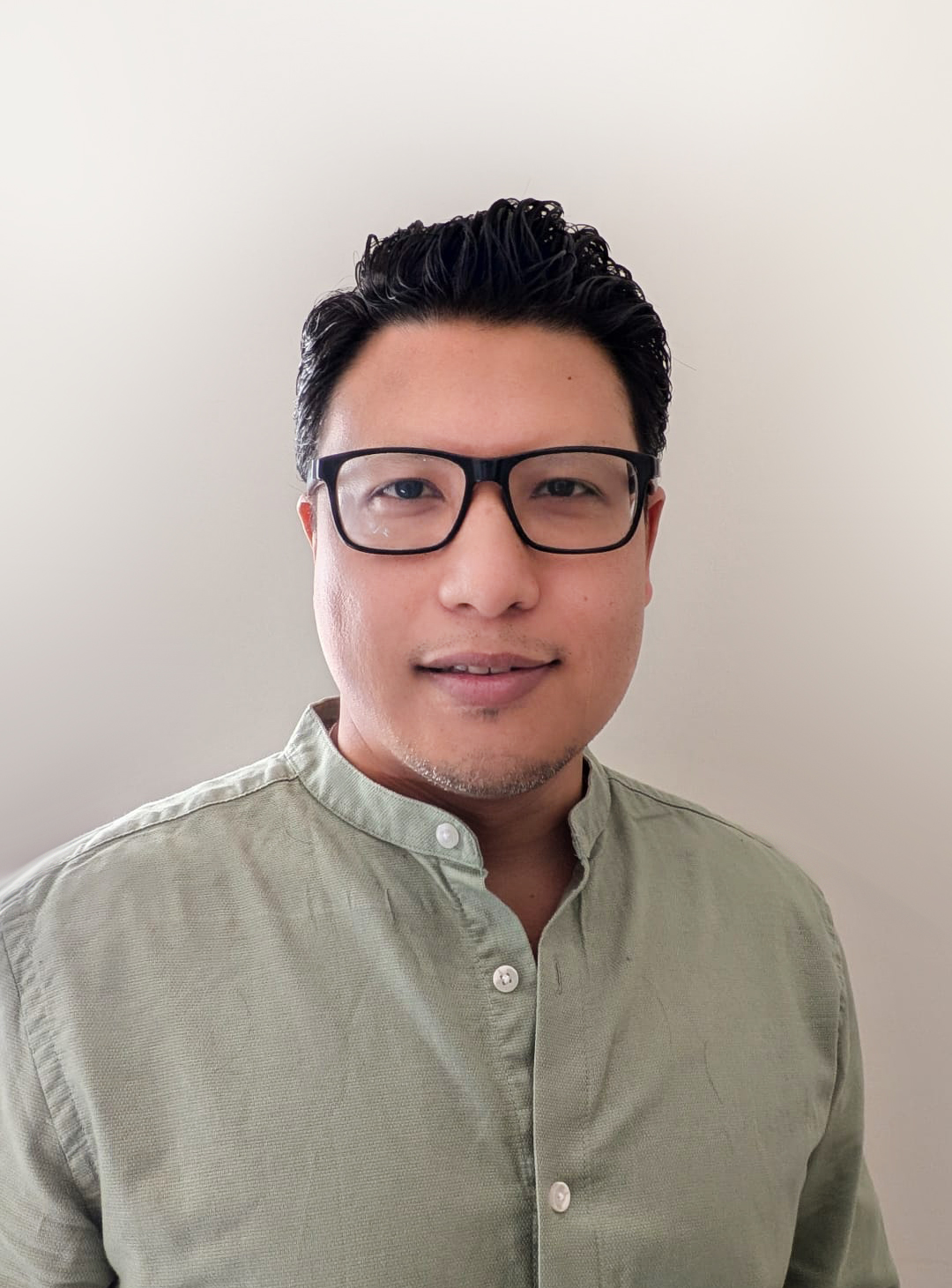
Jury
Sanyukta Shrestha
BAFTA Award Winner
Sanyukta Shrestha is a Nepalese filmmaker, animator, and art historian known for pioneering animation work. He directed Nepal’s first animated feature film, The Legend of Shankhadhar, marking a major milestone in Nepali cinema. His internationally awarded career includes the 2025 Best Animated Film Jaye Lakhay and a BAFTA Award for his work in interactive storytelling.
Q01
Your work bridges the gap between historical preservation and cutting-edge animation. How does your background as an art historian influence the visual style and themes of your films?
As an art historian, my research has focused on the medieval art traditions of the Kathmandu Valley. It is a culturally rich part of the world that remains relatively unknown to wider audiences. The visual language, storytelling sensibilities, and characterisation in my films draw heavily from this heritage.
Thematically, my films naturally document aspects of Nepal’s ethnic identity, which is rapidly declining, although I avoid addressing it directly in the narrative. I am drawn to elements of antiquity that have disappeared from everyday life but still embody a creative essence through their material culture. These often shape the settings, locations, and props in my films.
Through my work, I want audiences to experience a culture from a particular point in history, but in a way that feels lived-in rather than museum-like. As a visual storyteller, I spend more time studying illustrations, photographic archives, and historical sites than written records. This gives me confidence as a storyteller and immense joy as a filmmaker.
Q02
You directed and animated The Legend of Shankhadhar, Nepal's first animated movie. What were the biggest creative and technical hurdles you faced when pioneering an entire medium for a country?
It was an enormous emotional responsibility, especially as a first-time filmmaker. The project constantly challenged me to question whether it was even possible to push animation beyond short-form storytelling with such unconventional subject matter.
The film was made at a time when Nepal was recovering from a devastating earthquake that claimed nearly ten thousand lives and damaged countless heritage sites. The whole country was searching for inspiration. In my own way, I wanted to contribute to that recovery by connecting the idea of a rebuilding nation with the historical legend of Shankhadhar, whose act of paying everyone's debts is credited with beginning a new era in Nepal.
The experience also taught me what it truly takes to complete a feature-length animated film—years of commitment and patience. Since the story was set more than eleven hundred years ago, there were very few direct references for costumes, sounds, and everyday life. Much of the world had to be imagined from surviving architecture, artefacts, and oral traditions.
Q03
Animation is a notoriously slow and disciplined format, often taking years per project. How do you maintain your focus, passion, and artistic vision over such a prolonged production lifecycle?
Filmmaking is deeply process-oriented and full of real-life complications. It demands unwavering focus. In animation, a week of work may produce only four or five seconds of screen time. My recent film took eight years to complete and runs just over an hour.
It is normal to sacrifice holidays, family time, and much of your social life. There will always be doubts, and unfinished work rarely makes sense to others because only you can see how everything will eventually come together.
That is why it is essential to have a clear vision of the film from the beginning. No matter how long the journey, the core idea of the film becomes your guide. Whenever doubts arise, you simply remind yourself of the destination.
Q04
Having won a BAFTA for the children's virtual world Bin Weevils, how do you approach storytelling differently when creating interactive spaces versus linear films?
About twenty years ago, I was deeply involved in game development, at a time when multimedia and the internet were rapidly evolving. I was fortunate to work with a small team of highly creative colleagues who simply refused to grow old. Together, we built a virtual world that was entertaining, educational, and safe for British children.
In interactive worlds, the process is almost the reverse of filmmaking. As creators, we build the landscapes, characters, and rules, but the audience becomes the protagonist and creates its own stories. In many ways, you become both the maker and the audience of your own world.
What fascinated me most was how users constantly surprised us with stories we never anticipated. Designing these spaces became a cycle of observing behaviour, rethinking assumptions, and refining the experience. In games, you are not directing a story but creating systems that generate countless personal stories.
At one point, many believed filmmaking would merge completely with interactive media. But storytelling is one of humanity’s oldest activities. Technology can enhance it, but I do not think it can ever replace it.
Q05
Independent creators often have to wear multiple hats - director, animator, historian. What advice would you give to young indie animators who are struggling to balance the technical workload with the creative process?
Animation comes with the responsibility of being an actor too. At different times, you become a dancer, fighter, horse rider, hunter, and much more.
My advice is simple: filmmaking is a creative medium, and technology is only a tool. Software and hardware will always improve. There will always be a better camera, animation suite, or graphic device. Your creative instinct, however, is unique.
Read more books. The moments between sentences, chapters, and after closing a book are when your imagination begins building worlds of its own. That imagination is the seed of every film. Growing a tree takes time, but it starts with finding the most fertile seed.
Q06
Your projects often spotlight Nepalese heritage and culture. How important do you think it is for regional stories to find a platform in global, international festivals like ours?
Regional stories carry a great deal of humanity, which is something I value deeply. They are often rooted in innocence, truth, and cultural specificity—the very qualities that make creative work feel authentic.
These stories draw from local cultures, languages, and sensibilities, creating cinematic worlds that feel unique and believable. When regional films reach international platforms, entire communities gain visibility. Audiences across borders can connect with experiences that are deeply local yet profoundly human.
I have learned a great deal from filmmakers like Satyajit Ray, whose work demonstrated that the more regional a story is, the more universal it can become.
Q07
In a market heavily saturated with rapid, automated digital content, what do you think is the future of deeply intentional, human-crafted animation?
I believe this is precisely the time for human-crafted work to stand out. Content creation has become faster and more accessible, but speed often comes at the cost of authenticity and emotional depth.
As audiences become more familiar with automated production, they will also become better at recognising genuine creative expression. People will always be drawn to work made with care, conviction, and a distinct voice.
The future will likely be defined by a contrast between mass-produced content and deeply personal storytelling. In that environment, genuine creative instincts will become more valuable than ever.
Q08
When your recent work was selected as a finalist at our festival, what did that specific recognition mean for the trajectory of the project?
The Singapore Film and Script Festival was actually the first to recognise my recent film as I returned to the international festival circuit after two decades. During that time, I had lived a very different life, studying culture, history, and improving my animation skills.
The selection reassured me that the art film world still understood the creative language I speak. As an independent filmmaker without a professional network, that recognition was particularly meaningful. It helped bring international attention to the project, strengthened its credibility when approaching screening opportunities, and generated pride for the region and culture it represents.
Q09
Since you are now joining our jury panel, what specific elements or qualities are you looking for when evaluating other filmmakers' work? What makes a project truly stand out to you?
I am excited to join the jury panel for the next season of SFSF. I have immense respect for anyone who sets out to make a film. If a filmmaker has a genuine voice, the experience is usually rewarding for both the creator and the audience.
What I value most is engagement. Whether a film is thrilling or quiet, realistic or fantastical, it should transport me into its world. I do not need to know or even like that world, but I need to believe in it. Above all, I look for conviction in the filmmaker's expression.
A film truly stands out when it stays with me after the credits. Great cinema is not only about telling a story—it is about making us think, feel, or briefly live someone else's life. If I want to watch a film again, then I know it has succeeded.
Q10
Even though your next film might be several years away, can you give us a tiny hint about the themes, concepts, or historical eras you are currently exploring or hope to tackle next?
I enjoy exploring new territory, and I believe that is how one grows as a filmmaker. I am also drawn to themes that have rarely been attempted.
My previous films were historical and musical, but I am still interested in exploring different human emotions. The first film was about kindness and charity. The second explored love, anger, sacrifice, thrill, and suspense.
After completing my recent film, I began studying ancient religion and language, particularly Sanskrit. It has opened a fascinating world of cultural sensibilities, philosophy, and politics. I may explore something in that space, although I am not certain yet.
I only commit to a story when I am convinced that it needs to be told—and that I am the person meant to tell it. After all, it has to be worth eight years of my life. One thing I do know is that, for my next film, I would like to focus on directing rather than doing the animation myself.
Ready to submit?
Every entry is read and scored by our selection committee, and every Official Selection is promoted through our showcase.